Micro-credential
Applied Life Cycle Assessment and ESG Reporting for Circular Economy
StrongerBC future skills grant Applications Closed
This offering is no longer accepting StrongerBC future skills grant applications. Any new applications received will be treated as waitlist applications, and applicants will be contacted should additional seats become available. If you are interested in registering for the StrongerBC future skills grant waitlist, please click here.
ABOUT THIS PROGRAM
Learn practical methods to implement circular economy strategies in your organization with this two-part micro-credential program. Standard tools and methodologies will be presented, towards building lifecycle and lifecycle cost analyses in SimaPro software, for developing and communicating business plans to a variety of stakeholders. Learners will bring a case study from their place of work, culminating in an end-of-program presentation.
OFFERED BY:
OUTCOMES
Built strongly on the success of UBC’s Accelerating Circular Economy program, by the end of this program learners will be able to:
- Describe the fundamentals of the circular economy and associated business models (e.g., recycling, repairing, refurbishing, etc.)
- Apply tools and methods such as Lifecycle Inventory (LCI) diagrams, to define material flows and energy inputs/outputs, as well as system boundaries, for building simulations
- Perform lifecycle analysis (LCA) and lifecycle costing (LCC) modeling in the industry-standard SimaPro software to predict cost and environmental impact outcomes
- Perform “what-if” modeling scenarios in SimaPro, for identifying key activities and stakeholders that reduce waste and improve profitability
- Create a structured LCA report on your case study of choice, following ISO 14044 formatting standard
- Learn strategies for integrating LCA model results into ESG reporting and business strategic planning
Professional learners, able to make change in their organization towards circularizing value chains, including:
- Government (municipalities, supporting agencies, etc.)
- Large for-profit companies
- Small-to-Medium Enterprises (SMEs)
- Industry associations & non-profits
- Academics embarking in entrepreneurship
Entire Program:
$2,000 (Individual Course Fee: $1,000)
You may withdraw up to seven days before the start date and receive a refund (less a $50 administration fee) or a full fee transfer to another CPE offering with open registration. Please see Policy & Resources.
For details on refunds and enrollment deadlines, please see Policy & Resources.
Please click the course title for full schedule information
Course #1: Introduction and
Principles of Circular Economy
Dates: October 6, 2026 – October 31, 2026
Synchronous Sessions:
-
Week #1 (October 6, 2026): Tuesday
06 October, 12pm – 1pm Pacific Time
Course #2: Hands-on Sustainability
Assessment and Reporting Methods
Dates: November 3, 2026 – November 28, 2026
Synchronous Sessions:
-
Week #1 (November 3, 2026):
Tuesday 3 Nov. (Optional), 12pm – 1pm Pacific Time -
Week #2 (November 9, 2026):
Tuesday 10 Nov. (Optional), 12pm – 1:30pm Pacific Time -
Week #3 (November 16, 2026):
Tuesday 17 Nov. (Optional), 12pm – 1:30pm Pacific Time -
Week #4 (November 23, 2026):
Tuesday 24 Nov. (Mandatory), 11am – 2pm Pacific Time (guest lectures)
Delivery Mode:
Online
Structure:
The program consists of a total of 56 hours of synchronous classes and asynchronous readings, exercises, and assignments. Each course spans 4-weeks, with 7hrs of learner commitment per week, for a total duration of 28hrs per course (56hrs for both courses). Throughout the program, learners will (in parallel) learn the skills and tools through direct instruction, assigned readings and worked problems, while also applying it to a selected case study from their workplace. This document is intended to be a vehicle to apply the course content to the workplace case study, carried forward into downstream development and triage in collaboration with UBC’s MMRI, and other identified stakeholders.
Technology Requirements:
- Access to a computer with a modern operating system
- Installed browser (e.g., Microsoft Edge, Google Chrome) for accessing online resources
- Adobe PDF viewer
- Enough hard drive space to install Zoom
- High-speed internet connection for:
- Course 1&2: Word and spreadsheet software of the learner’s choice to edit and submit assessments (e.g., Google Docs and Sheets, or Office 365)
- Course 2: Connecting to online virtual machine with OpenLCA installed
- Course 2: A Microsoft account to login to the virtual machines (users can create a new one, or use an existing personal account, or use an existing institutional account)
- Access to an email client
- Microphone, webcam, and headphones or speaker
Program Instructor and Developer
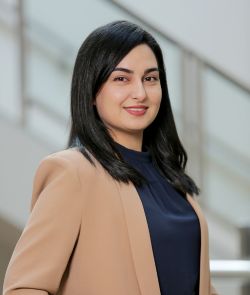
Dr. Niloofar Akbarian
Dr. Niloofar Akbarian is a Senior Research Associate in the Accelerating Circular Economy program of Materials and Manufacturing Research Institute (MMRI) and a Postdoctoral Teaching Fellow at The University of British Columbia. Her research expertise focuses on the intersection of Applied Operations Research (OR), Sustainable Supply Chain Management, and Business analytics. She has led MITACS Accelerate– and MMRI-IRAP Circular Economy Seed–funded industry projects in bio-industrial manufacturing, developing Decision-Support Systems (DSS) for sustainable decision-making under uncertainty. In 2025, she was appointed Lead Instructor for this micro-credential course, integrating hands-on SimaPro training with real-world industry case studies on circular economy topics, including sustainability quantification and scenario modeling under uncertainty. Dr. Akbarian holds professional certifications from the American Center for Life Cycle Assessment (ACLCA) and One Click LCA.
Past Contributors
Upon successful completion of all program requirements, learners are awarded a UBC Okanagan Letter of Proficiency (a non-credit credential). Learners will also receive a verifiable digital badge (which has descriptive metadata about the learning achievement) for sharing through digital channels.